 |
 |
 |
 |
||
|
|||||||
|
The
Compleat Trainor |
|
||||||||||||
How do you see training? |
AS A TRAINER --- What type of training do you give? Why do you train? Whom do you train? How do you train? (Method) |
I see learning as…. |
AS A LEARNER: I enjoy learning most subjects or courses on… I hate it when I have to learn … I learn best when … I do not learn at all when … Learning becomes boring and dull to me when … Learning becomes enjoyable to me when … |
What type of training do you give? |
· TECHNICAL · CONCEPTUAL · SOCIAL · PERSONAL |
Why do you train? |
· To create awareness · To inform/educate · To shift an attitude · To develop skills/habits · To create a change |
Whom do you train? |
· Kids/adults · Leaders/managers/workers · Professionals/techies · Other beings |
How do you train? |
· Fishbowls · Lectures · Role plays · Group discussions · Case studies · Hands-on practice · Feedback/critique · Demos · Journalizing · Reflection · Structured learning activities |
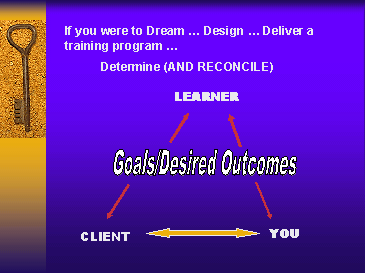
Desired goals/outcome |
|
|
|
The moment you know: · where your learners are · What your client wants · What they should learn Plan how to get them….desired goals/outcome |
Training plan options |
Strategize how you will · entice learners · execute the design · enhance the learning · outcomes |
Developing a training program |
· Test it · Do it · Run it · Learn from it |
Myths |
· There is only one way to teach a subject or course. · This ONE way will apply to all types of individuals who have to learn this one concept or skill. · Training is easy to do, as long as you are the expert in the field, you can teach it. · Learning can be forced. Reward them if they show they know. Bop them on the head if they don’t learn as fast as you want them to. |
Training realities |
Learning is a process that involves… · Physical · Intellectual · Emotional · Volitional ….capacity of the learner |
Capacity of the learner |
· The mental state of the learner is a determinant in the CAPACITY and SPEED OF LEARNING. · The SELF ESTEEM, STRESS LEVEL, LEARNING STYLE, AND MOTIVATION of the learner is a fundamental concern in training. · All trainees can learn but NOT ALL CAN BE TAUGHT USING ONE TRAINING STYLE. · A TRAINEE-CENTERED INSTRUCTIONAL APPROACH must have a fundamental respect for the RIGHTS, CULTURE, HISTORY, of the TRAINEE. |
|
|
Instructional model |
Learning is complex and uniquely different for each learner, therefore, instructional models must cater to the --- · SENSES · LEARNING MODES and · INTELLIGENCES Of the learner |
Traditional Intelligences |
Loooooooong ago … People thought there were only two kinds of INTELLIGENCES TO DEVELOP: · Numerical · Linguistic |
Multiple intelligences |
Then not so loooooooong ago, a man named HOWARD GARDNER said that there were MULTIPLE INTELLIGENCES… · Numerical · Linguistic · Visual · Kinesthetic · Interpersonal · Intrapersonal · Musical
|
Additional Intelligences |
Now …. There are still some additions to the list: · NATURALIST INTELLIGENCE… · SPIRITUAL INTELLIGENCE… · EXISTENTIAL INTELLIGENCE… · SEXUAL INTELLIGENCE… · AND GOD KNOWS WHAT INTELLIGENCE |
|
Learning styles |
In a way, the study of intelligences gave rise to the study of different learning styles … In
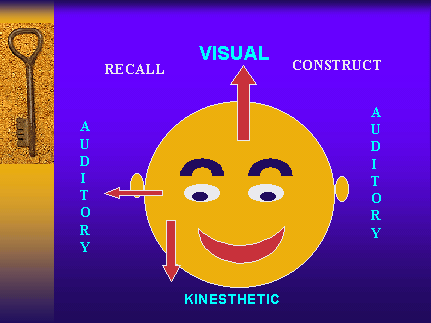
Neuro-Linguistic Programming: · VISUAL · AUDITORY · KINESTHETIC In
Accelerated Learning: · Somatic · Auditory · Visual · Intellectual
|
Accelerated Learning |
· Somatic – learning by moving and doing · Auditory – learning by talking and hearing · Visual – learning by observing and picturing · Intellectual – learning by problem solving and reflection |
| Stimulating Kinesthetic or Somatic Styles |
· Building models of processes · Physical manipulation of components/demos · Structured learning activities and games · Outdoor exercises · Creating pictograms and peripherals · Acting Out/Roleplays · Doing projects · Field tripping/drawing/writing/moving · Combining methods that integrate all styles |
Stimulating Auditory learning |
· Reading out concepts aloud from manuals/computer screens · Rephrase a concept and record it – listen several times · Compose rap or music about a concept · Create their own newscast about what they have learned/tell stories · Repetition of a concept but spoken in different tones, rhythm or cadence |
Stimulating Visual learning |
· Picturesque language (metaphors and analogies) · Graphics presentations/drawings/creation of visual aids · Making 3 dimensional objects · Dramatic body language · Writing a poem, an essay or telling a story/cartooning/icons · Field observations/ · Mental imagery |
Stimulating Intellectual Learning |
· Solving problems · Analyzing experiences · Doing strategic planning · Brainstorming · Accessing and distilling information · Formulating questions and research · Creating mental models · Applying new ideas on the job · Thinking through the implications of an idea |
Final Tips -- keys To Effective Training |
Remember that there are four phases to training: · Preparation (arousal of interest) · Presentation (initial encounter of new knowledge/skill) · Practice (integration of new knowledge/skill) · Performance (application of new knowledge/skill to real-world situations) |
Preparation |
BE CONSCIOUS OF: · What & WHY you want to teach, HOW & WHERE you will teach (Your results-Org’l results) · The interest, needs, learning styles, competencies of the learner & resistance · Environment for learning and maintenance GET A FEEL OF THE BARRIERS TO LEARNING HAVE OPTIONS READY TO SWITCH TRAINING TECHNIQUES (VARIETY AND NEED) |
Presentation |
· Consider that there is more than 1 way to teach a skill or concept. · Expose trainees to: collaborative knowledge sharing, observations of real world, interactive presentations, DEMOS, games, graphics, team-based, dyadic learning, discovery exercises, problem solving, simulation, and so on. · WHAT YOU THINK IS THE BEST WAY TO TEACH may not necessarily match the LEARNING STYLE OF THE TRAINEES…. |
Practice |
The training techniques you use SHOULD MATCH: · the Learning styles, · the results you want to get, · the concept or skill you are teaching with the real-world conditions. IT IS MATCHING & INTEGRATING THE CONTEXT OF THE TRAINEE/LEARNER WITH THE CONTENT. |
Performance |
This involves planning and strategizing how the learning sticks and Is applied successfully.
Make provisions for immediate real-world application, creating & executing action plans, follow-through reinforcement activities, on-going coaching, performance evaluation and feedback, peer support, supportive organizational and environmental changes. |
Reasons why learning fails to stick |
O No immediate need to apply knowledge or skill O No support system to reinforce learning on the job O The company culture or work situation is antithetical to the new learning O No rewards for successfully applying the new learning O No/unclear consequences for not applying the new learning O No time to integrate and apply new knowledge or skill |
Summary |
Learning is
the process of turning experience into knowledge, knowledge into understanding, understanding into wisdom, and wisdom into action. |